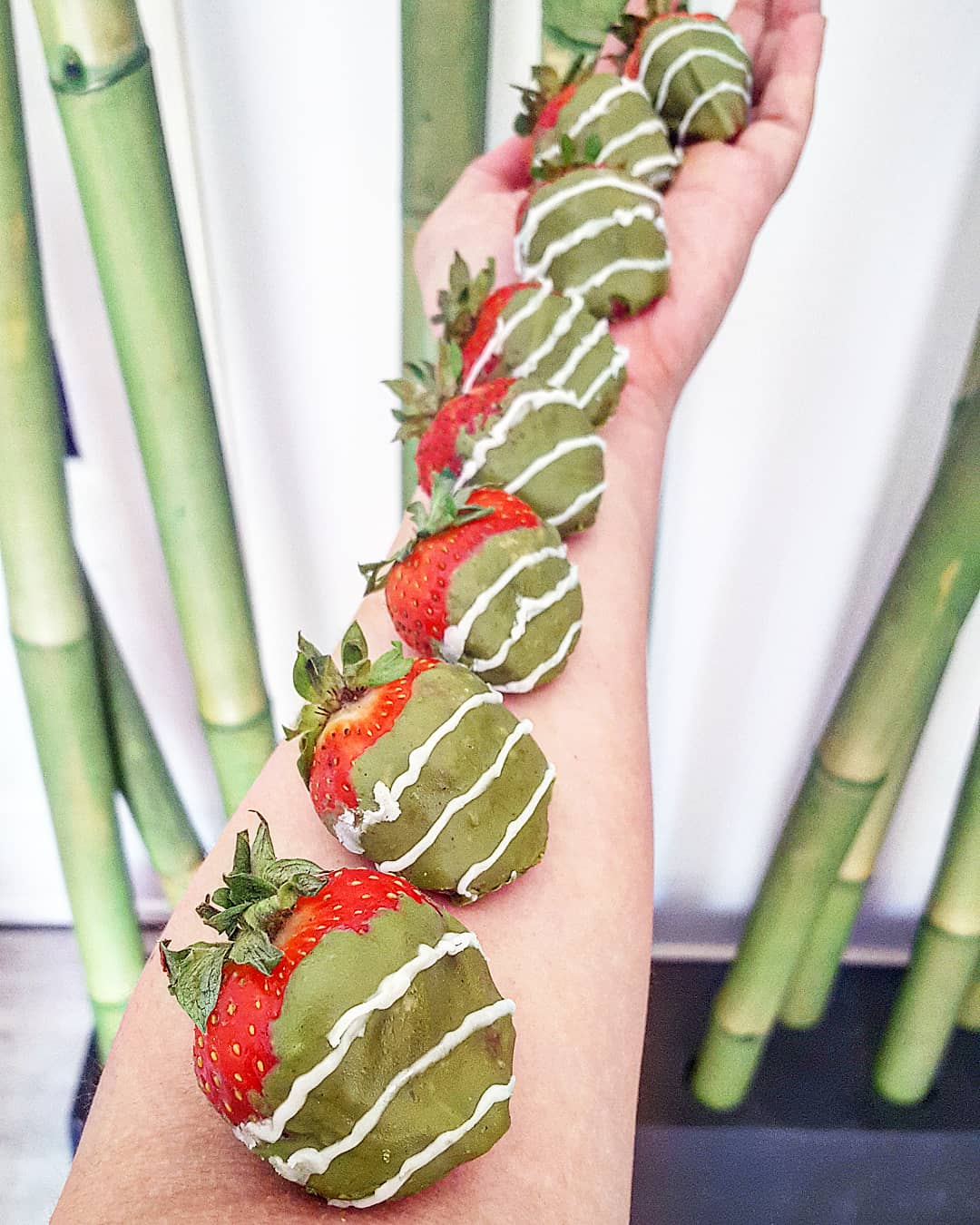

My love for matcha started in Japan. I noticed when I was in Japan that matcha was processed in many products and out of curiosity I had to try everything there. As soon as I tasted the matcha for the first time, I got addicted to it and I wanted more. Here in Holland, we have the matcha bar Hug the Tea in The Hague and matcha bar in Amsterdam. Still, I couldn’t find anywhere in Holland a shop that sells matcha strawberries. I decided then to make the matcha strawberries myself and i want to share this easy-to-make recipe with you so that you can also make it yourself.
Ingredients:
- 2 tbsp matcha powder (I used the matcha powder from Hug the Tea, but you can also use another brand of matcha)
- 100 gram white chocolate
- 1 tbsp coconut oil (if you don’t like coconut oil, you can use another variation of oil or no oil)
- a pinch of salt (you don’t have to use salt if you don’t like it)
- 20 strawberries
- Ice water: fill the bottle with water and put it in a freezer for half an hour, or use ice cubes in a bowl to cool the hot melted matcha chocolate.
Preparation method:
First, gently wash your strawberries clean and pat them dry with kitchen paper. Then place the strawberries on the (oven) plate with baking paper.
Place a heat-resistant bowl with the ingredients (2 tbsp matcha powder, 100 grams white chocolate, a pinch of salt, and 1 tbsp coconut oil) in a pan of water or on top of a pan (au bain-marie). Ensure no water enters the bowl. Bring the water to a boil.
You keep stirring with a spatula in the bowl until the ingredients are well mixed, smooth and melted.
Once it has melted, you place the bowl with ingredients in another large bowl of ice water or ice cubes to let it cool down and then stir the matcha chocolate well for 2 minutes until it thickens.
Dip the strawberries in the mixture and place them back on a plate with baking paper. (You can decorate with, for example, chopped nuts or candies.)
When the matcha chocolate begins to solidify, reheat it by placing the bowl back on or in the pan of water and bringing it to a boil until melted. Then place the bowl in another bowl of ice water to cool, and stir until the mixture is dippable again.
Once all strawberries are coated and arranged on a baking sheet with parchment paper, refrigerate for 20 minutes to harden.
If you haven’t decorated your matcha strawberries with chopped nuts, candies, or other toppings after dipping, you can still decorate them after the 20-minute chill. Try glazing them with a simple recipe (see below). You can also add chopped nuts to the glaze. Be creative or keep it simple—it’s your choice. Matcha strawberries are delicious with or without decoration.
A very easy-to-make glaze recipe:
100 grams powdered sugar (or icing sugar) and 1 tbsp liquid, such as water. For color and flavor, use lemon juice, orange juice, fruit juice, vegetable juice, or lemonade syrup.
Stir the icing sugar together with the liquid until you have a thick syrupy liquid that is also shiny. If necessary, add more icing sugar or liquid to the glaze.
After decorating each strawberry, place them back on the plate with baking paper and return to the fridge. After 20 minutes, enjoy your matcha strawberries.
From my experience and from others I know, the matcha strawberries with or without decorations are delicious, and I hope you’ll like them too.
Have lots of fun making matcha strawberries. If you have any questions or you like them, you can like my post and leave a comment. If you post a photo of your matcha strawberries on Instagram, tag me and use my hashtag #marilyn_amaterasu. I am very curious about what you think and how you made it.
An explanation for people who don’t know what matcha is
Matcha is green tea from Japan, though its history begins in China. During the Song Dynasty (960–1279), powdered tea made from steamed and dried tea leaves was popular, with the powder and hot water beaten together. Zen Buddhists from Japan encountered matcha during their travels in China and later developed their own traditions and production methods. Tea plants grown for matcha are shaded for about three weeks before harvesting, usually with mats or sails. This shading causes the Camellia sinensis plant to produce more L-theanine and caffeine, a combination responsible for the soothing and calming effects matcha drinkers experience.
Matcha is a powdered tea consumed differently than loose-leaf or bagged tea. The powder dissolves quickly in liquid such as water or milk.
Matcha features prominently in traditional Japanese tea ceremonies, where great attention is paid to preparation, serving, and drinking. The powder is whisked with water between 60–70°C into a foamy green liquid. Depending on tea quality, the liquid ranges from thick to thin, but whisking longer than 30 seconds makes it too bitter. Matcha is an exclusive, bitter drink rich in amino acids, vitamins, minerals, and caffeine.
Today, matcha is widely used as a seasoning in soba noodles, ice cream, lattes, and many other products.
Leave a Reply